 A few years ago (January/February of 2012) we updated our basement. Previously it was a large open space that felt a little cold and it’s shape made it odd to furnish. EDIT* Please read the entire post and comments. I made this post in 2013 originally, to share the trials I went through before this became popular online. There wasn’t any information on how to pour how thick to pour etc. Especially for this type of pour. As I say in the post I share the way I did it and how I fixed it to help someone in the same situation. I have done this again a few times since and I always to a light pour just to seal the corks first then do two more light pours to fill. Sometimes if it’s not perfect, I sand and do a final coat. Hope all of this helps you with your project.*
The room had is where our gym equipment, a sofa and chair, a hutch with a tv, and our piano all sat mismatched together. Our main level had a small living/dining area that wasn’t big enough for entertaining or for family gatherings. A basement renovation made sense for our family and with the amount of entertaining we did for our work.
My husband had never really wanted a mancave in any of our past homes, but it made sense in this home and a great feature for resale. At the time I had worked part-time as a cabinet maker’s apprentice. I loved the working in the shop, but my shoulder eventually decided it couldn’t daily do that type of work.
When planning the renovation I couldn’t decide on what I wanted for a countertop. The artist in me prefers unique and the frugal part of me loves getting great quality for less. Many years ago, when Debbie Travis was on TV, she did a project where she made a tray where she placed pictures, lace, shells, and little things that were important to the homeowner and then poured an epoxy over the top. I always wanted to make one of those. This project developed from that idea, to building a coffee table with the same idea but filled with corks, to this.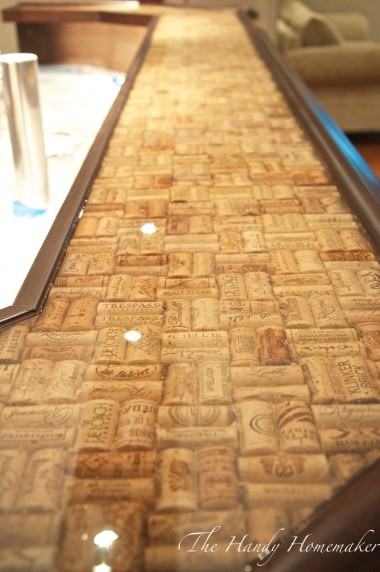 As the cabinets were ready to be installed and the project was coming along, I changed gears from the coffee table to why not turn that idea into a bar top counter. I explained to my cabinet buddy (CB) what I planned and he helped build a tray for me to do my magic in.
Materials:
- Level tray/pan with plywood or wood surface with frame
- Table or Bar top clear Epoxy on eBay
- Corks- (approximately 84 corks a square ft)
- Glue (wood glue, gorilla glue, I had carpet glue on hand that was the same color as the corks so I used that) The glue needs to be clear or similar color to the corks once dry.
- Clean wooden stir sticks (paint sticks)
- Rubber Squeegee or Rubber Spatulas
- scale or measuring cups
- sharp knife and/or mandolin
- Large Clean Container for mixing. I used a large bucket
- Disposable gloves (This is a sticky product if you get it on yourself)
- small level
- Clear silicone caulk and caulking gun
- Clean rags/old cloth for clean up
- Painters tape and plastic sheeting to cover areas you don’t want to get epoxy on
- toothpicks to break bubbles
- heat gun
 Here is the front panels of the bar before the corbels were installed. The length of the bar is roughly 10’x3′, the depth of the inside tray is 11″. I didn’t have this blog when this room was finished and I only pictures for my personal record. Which unfortunately means I am missing pictures of a few steps. I think you can get enough of how to recreate this yourself with the ones I did take.
 Here is what the corbels look like once installed. We installed corbels across the front edge of the front panels of the cabinetry peninsula. Then attached the 3/4″ plywood base to fit the space. Edged the back with strips of stained and finished 7/8″ x 1-3/4″ birch. The edge piece was glued and nailed to the edge of the plywood base with a 1/8″ bottom lip. The bar rail was attached to the front of the plywood. The highest point of the bar rail sits 1/4″ higher than the back edge.
  Here is how the end of the bar rail looked like once cut and attached on site before stained and sealed. The back edge rail had to have a custom notch to accommodate the curve of the bar rail.
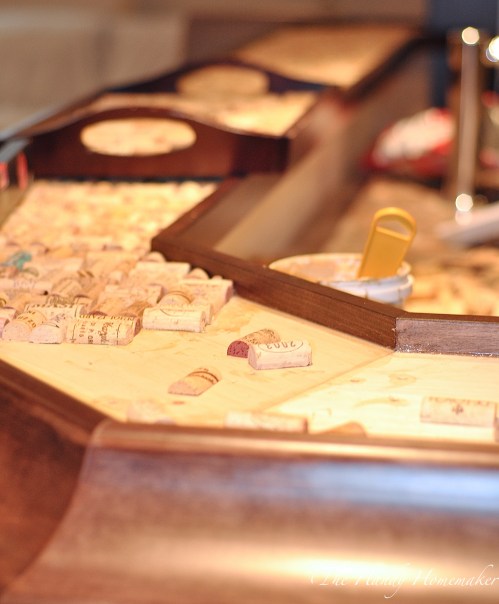 Here you can see the shine of the silicone caulking that I place in all corners and joints to prevent the epoxy from leaking once poured. This step is very important
 I’ll just put this out there. I used a lot of corks!!! There is about 84 corks per linear foot of top. That’s about 1100 corks in total!!! Did I drink all that wine, you ask??? Well, a couple special corks came from bottles that were enjoyed by me, however, I ordered the bulk (2000 corks) from an eBay seller. There were many corks that were from wine kits, which I didn’t like the look of for my project. I would message any seller and ask that question before hand if I was buying again.
IF you cut them directly in half you will need half the amount. I wanted them to look like full corks so to give this illusion I didn’t cut them directly in half. I cut so that a little more than half of the cork would be remaining. This also depended on the cork thickness (depth) as all corks are not created equal. As a guide I picked a 1/2″ as my measurement and tried to keep each cork close to that depth. It doesn’t need to be extremely exact….just close. When I planned the depth of the countertop pan/ tray to set the corks in, I planned that the depth may be slightly off. The pan was 1 inch deep, 1/2″ corks, 1/8-3/8″ lip to accommodate spills. This meant epoxy would be about 1/8 to 1/4 thick over the top of the corks. You will have a little room to play with. * If you don’t have a straight or square pan to fill save all the little pieces of cork. They will be needed to fill in the small spaces next to the edges on the turn as shown below.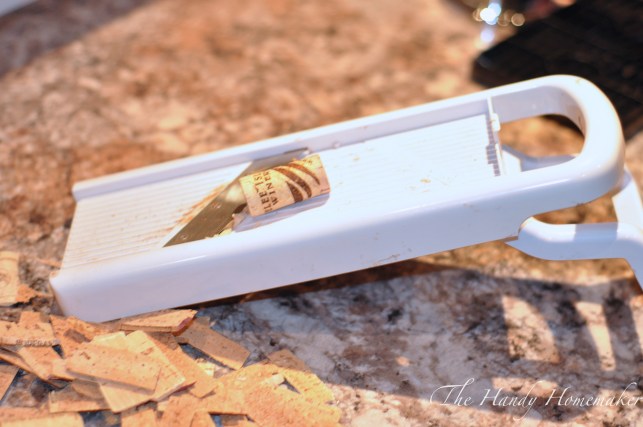 I used a cheap mandolin to take off any excess height of the cork. Of course, you could use the sharp knife or a good sharp vegetable peeler works too. Please use the slide attachment that goes with the mandolin and be extra careful. Especially if you have never used one. Mandolins are very very sharp!
  I didn’t take a picture of the lines I placed on the wooden pan to use a guide to keep my lengths of cork straight. I decided to use a two by two pattern alternating the corks. I matched cork sizes up in rows of two before hand that way I could make the rows look even. Not only are the corks not the same diameter but they are different lengths. So keep that in mind when you are laying them out. *You can see in this photo the why the small bits and pieces of cork are needed when you have turns or angles in your top
I did something special in the weeks before the top was ready to be made. If we were out to dinner, or if we had guests in, I would get them to sign a cork to be placed in the bar top. 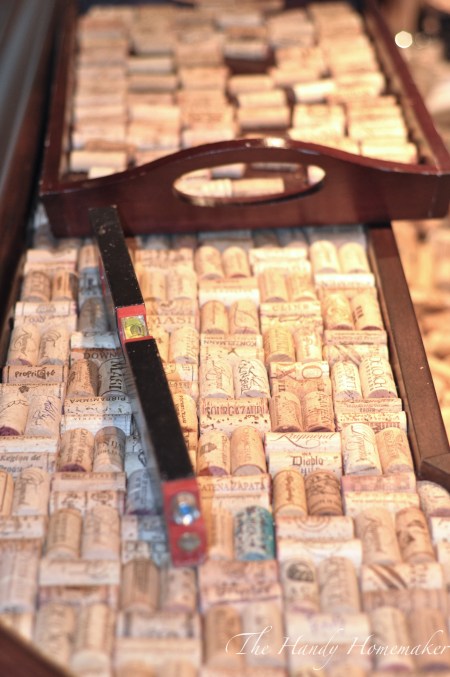 You can see my trays of pre matched up corks in rows. Keeping them in pairs helped make laying them in place much faster and limits mistakes like the rows being off.
Keep a small level with you as you lay down each row checking for level as you go along. I play a row down. Make sure it fits in straight and equal, then I lift that row being careful not to mix up, spread the glue in place and press the prepared corks back in place. Check again for level of the glued down corks every couple of rows.
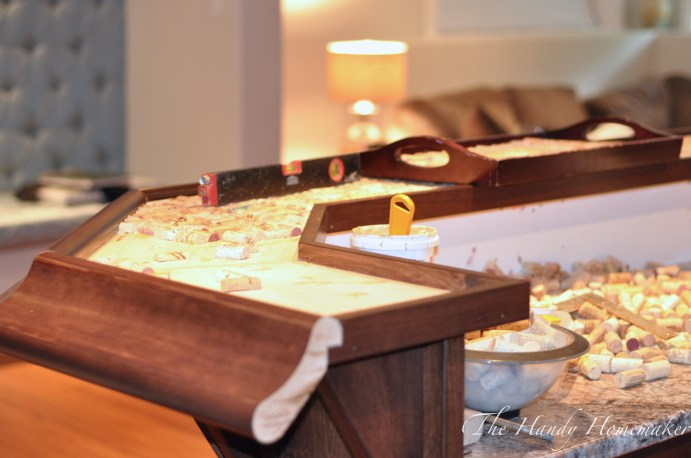 I kept the corks level the entire way across. This end was slightly out of level because the floor was so far out of level on the turn. I divided the difference between the bottom of the bar unit and the counter. This meant that these corks were a little thinner and that end had close to a 3/8″ lip (top of epoxy to top of wooden pan) vs a 1/8″ lip across the straight stretch.
  After all the corks are glued in place let dry overnight. Then using painters tape, tape plastic edging to the sides of the bar rail and back rail. Then take another strip of tape are carefully place along the edges to keep excess epoxy off. If you do get epoxy up the edges you will need to wipe off the excess before it hardens.
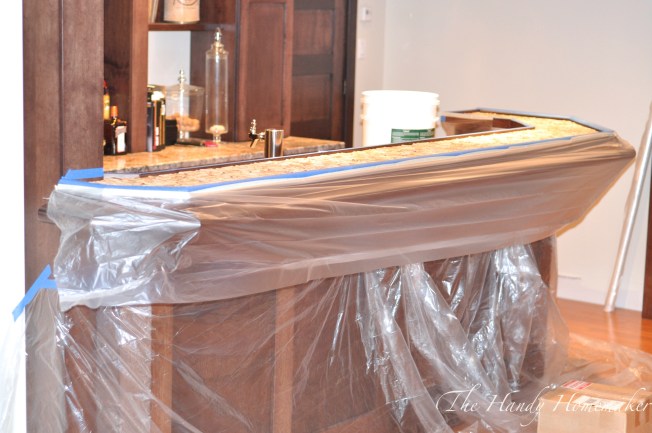 Plastic sheeting taped on the sides and the floor of the area.
 Mix the epoxy as per the manufacturer’s instructions. It was in the winter when I was doing this project so I placed each of the two part epoxy containers in my sink filled with hot water. This makes the epoxy easier to pour and mix together. The two part epoxy I used was extremely easy to mix together. I used spatulas to mix the epoxy to scrape as much of the mixture away from the bottom and sides as possible while stirring with slow and smooth motions. This helps prevent soft spots of epoxy that wasn’t mixed well. I will be mixing the first seal coat to seal in the corks and then finish with a 1/8″ thin finish coat.
 Once you have finished mixing the two-part epoxy according to the directions you are ready to pour. Slowly start pouring the epoxy over the corks while spreading with a spatula to get in all the nooks and crannies between the corks.
 This is definitely a good time to get extra hands. Mr. Handy, our son Cameron, and our friend Pat are on board to help with pouring and spreading the epoxy. I had never seen this done nor could I find any information on how to do a project like this online so we are winging it.
 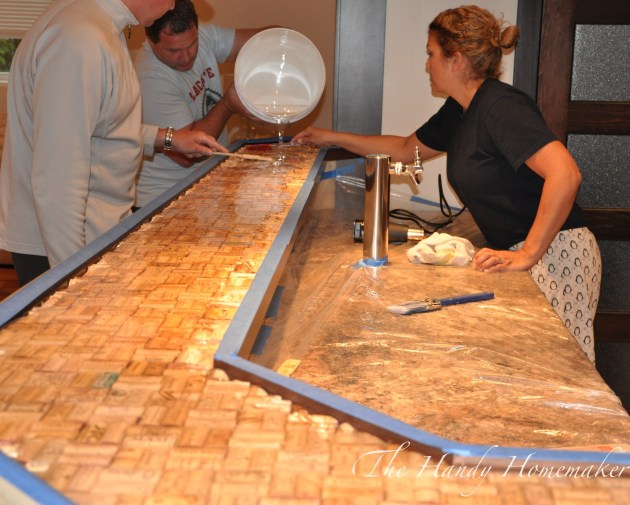 Yes, that is a set of my work pajamas. LOL Surprisingly I am not wearing my favourite paint covered pants and T-shirt. Part of the reason I don’t like to make videos or be in pictures is that I don’t have time to “doll” up when I am in the middle of projects. So this is what I look like. Ok now that we got that straight. Keep spreading the epoxy.
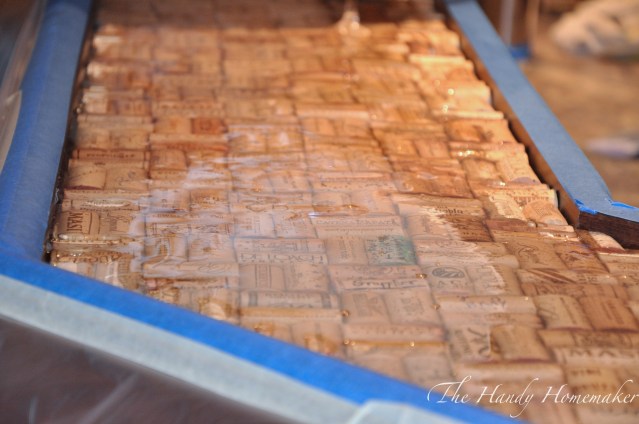 Using your squeegee or spatula keep spreading and pushing the epoxy into the corks and spread to the edges. It’s still heavy and gel like because it is cool in the basement. However once we hit it with the heat gun it starts to spread and sink in around the corks a little more smoothly.
 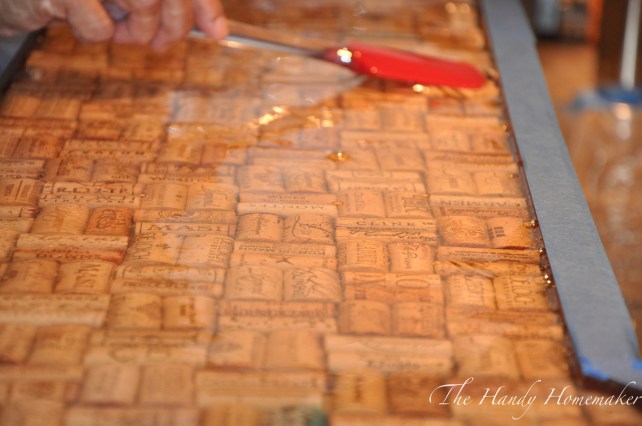 I had to mix up another small batch of epoxy to finish the pouring.
  Looking good! Now immediately wipe off and then remove that protective layer of painters tape that is against the bar rail as you don’t want any epoxy that may have gotten on it to harden with the tape underneath it.
 Using toothpicks to break bubbles and direct the epoxy into the corners
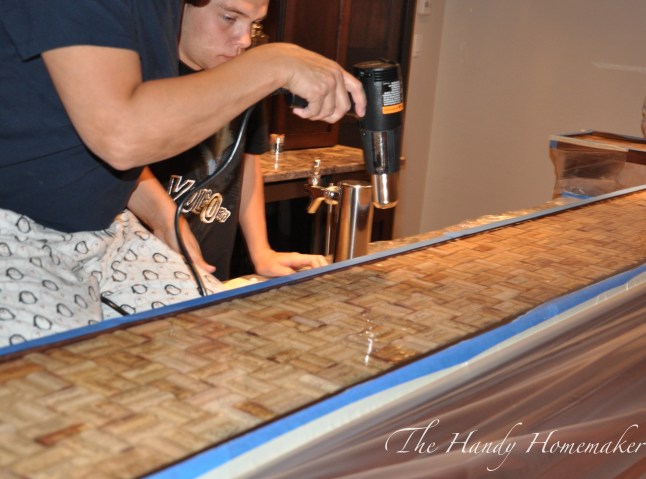 Now to apply a little heat from a heat gun. This helps the bubbles rise to the surface. I stress… Use a little heat. Less is more in the case of 2 part epoxy. Using a hairdryer could make ripples in the finish.
 Ok……. Here is why I needed a tutorial like this when I did this project. DO NOT UNDER ANY CIRCUMSTANCES APPLY TOO MUCH HEAT!! I can’t stress this enough. What happens is that if the epoxy is too warm and your room is a little cool, the top will start to cool and set before the underneath epoxy that is yet to harden. I was going to leave this part out and tell explain only how to get to the finished project. However… If your over zealous like we were, well… the next few steps to show how to fix it are important.
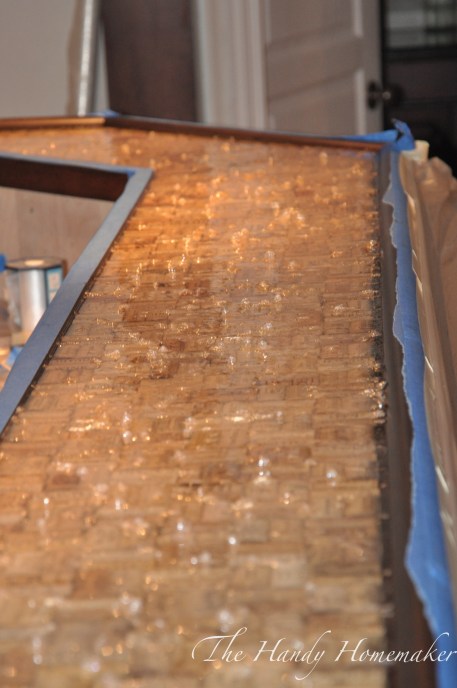 Overheating caused the epoxy to release bubbles to break the surface that is cooling thus giving you large stalagmite style bubbles along the surface, and all you can do is sit back and watch it happen. Well possibly you might sit down and cry for a few minutes like I did. I said this project was unique, and less expensive, than say… a granite countertop, but it is not free. I thought I ruined everything.
 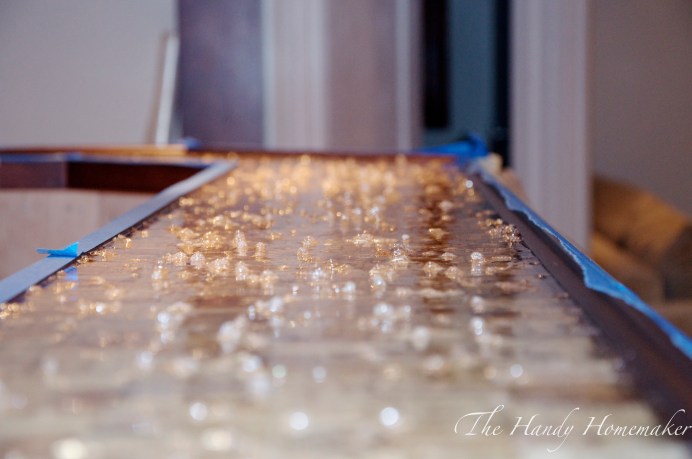 This is not how I pictured the day ending. Our friend Pat decided it was time to head home before he witnessed me bawling my head off. I went to the internet and tried to find the epoxy stalagmite expanding help desk. Unfortunately there wasn’t one that I could find. Mr. Handy was so sweet in trying to reassure me that it didn’t matter. Worst case scenario we need to start from scratch. Start from scratch!!! Are you crazy…. That’s a huge waste of time and money. I cried a little longer. Then I fell asleep. In the morning I woke feeling refreshed and I had thought an idea on how to fix it. I used a wood hand planer to chip, and scrape off the large pieces of epoxy, sanded with course 60 grit then 100 grit sandpaper and then another thin 1/8″ pouring of epoxy.
 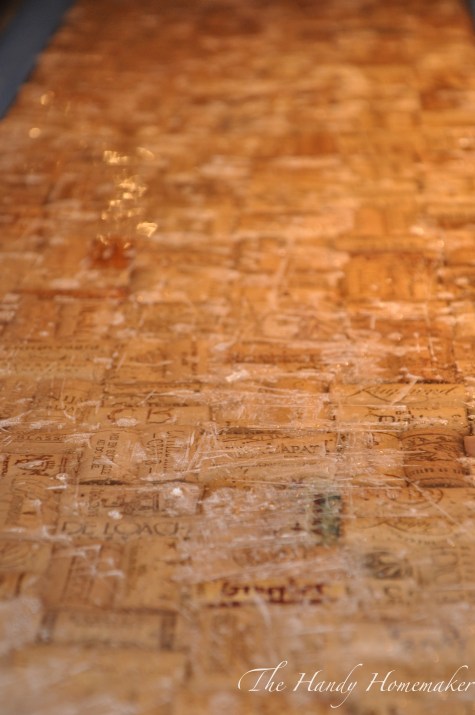 I scraped off the stalagmite sized epoxy.
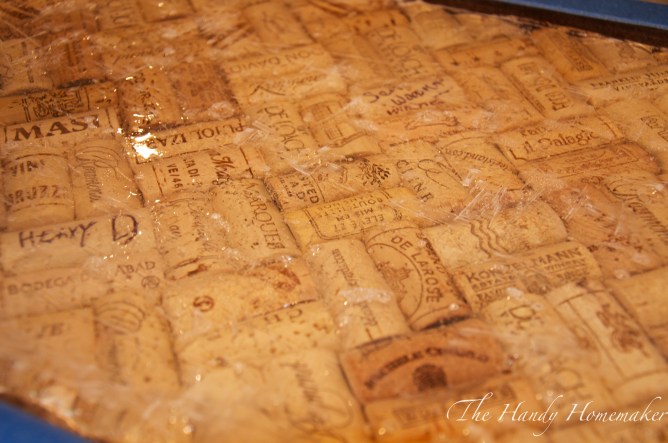 I used the edge of it to dig out some large bubble that were just under the surface.
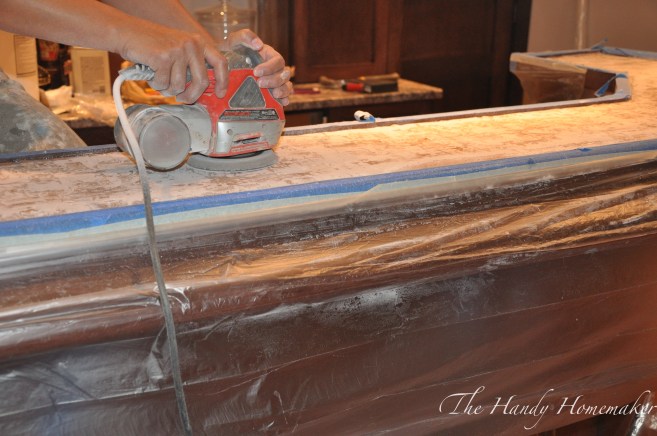 Then I sanded it as smooth as possible taking care to tape out the wood and not hit the sander on the wood.
  It looked like this and yes I was still worried. I vacuumed and cleaned up as much of the dust and chipped epoxy as possible. I wiped it down with acetone or alcohol and then poured a thin layer of epoxy. Smoothing it out to the edges and corners. Remove the protective tape and then give it a light pass with the heat gun and let it harden. The humidity and how cool or warm the room you are working in affects drying time. Do not touch it!
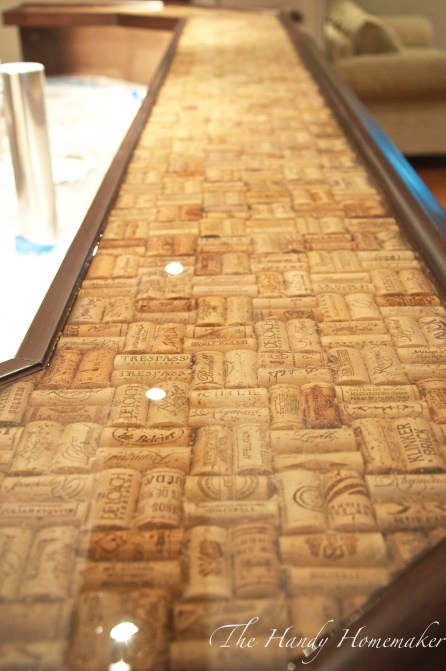
I walked away and left it and a few hours later it looked like this!!  It was hard, shiny and smooth!! I just love it!!
 The corks are clearly visible and most people think it is topped with glass.
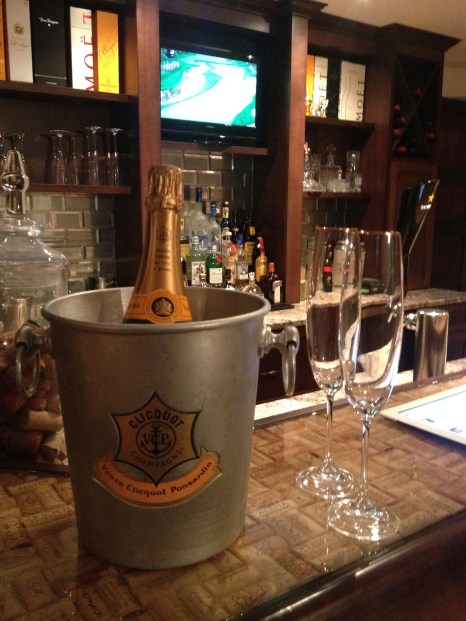 When the basement was finished we toasted to it’s completion. Myself, my daughter Chelsea and my gf Heidi.






 Dandelions & Dates
Leave a reply to Caroline Jensen Cancel reply